


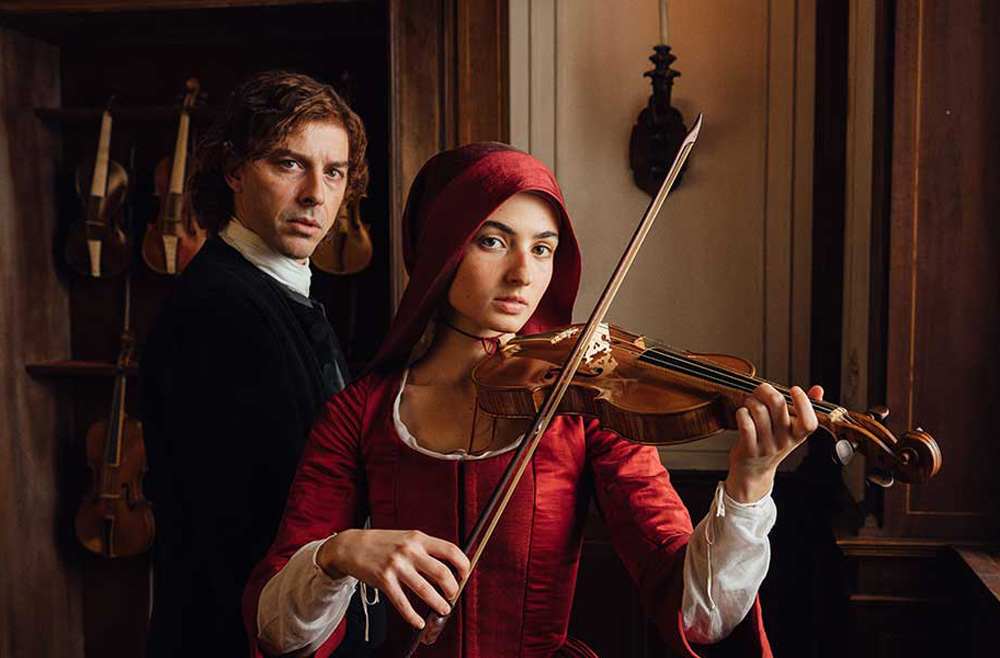

“Where there’s music, there can be no evil,” someone tells Cecilia (Tecla Insolia) late in “Primavera,” who clearly knows a bit better even when it’s revealed that the person quoting Cervantes’ “Don Quixote” to her hasn’t actually read the book. There is plenty of music in the young woman’s life, but little harmony when she’s been a resident of the Orphanage della Pieta in Venice since birth where operations to take care of the children are primarily financed by patronage for their music program and their resulting performances where they are heard but not seen, set back behind a grid where the sound of their instruments reverberates but they remain anonymous. Cecilia, now in her teens, has grown well past the point of being angry about her fate, resigned to playing the violin as passionately as she can when there isn’t much of an alternative, but in bringing joy to others, she doesn’t feel it herself.
There is an obvious narrative that director Damiano Michieletto and co-writer Ludovica Rampoldi deftly sidestep in adapting Tiziano Scarpa’s 18th-century set historical novel to the screen when Cecilia is inspired to embrace her violin as a potential tool for liberation with the arrival of a new musical director at the school, but it isn’t because she becomes any more enamored of pulling the strings, actually having little control over her own destiny when she’s promised to marry a soldier upon his return from the ongoing war. She does however gain a greater appreciation of her worth with the encouragement of Don Antonio (Michele Riondino), the new instructor who is also seen having little of it himself as a prodigy that has since taken ill, retaining his name recognition enough to be a potential draw for wealthy patrons who have started eying other orchestras to spend their Sunday afternoons with rather than Pieta, but comes at a cost of less than half the current conductor. Amusingly enough, “Primavera” wouldn’t have likely reached the screen if it wasn’t for his name either when Don Antonio’s surname is Vivaldi, though a knowledge of the “Four Seasons” composer’s future notoriety is largely used to suggest that many aren’t appreciated in their own time.
That’s certainly true of Cecilia, who has long understood that she’s a commodity in the orphanage where no one performs in the orchestra for pleasure but to raise cash for the operation that doesn’t make the orphans’ lives any better and the best one can hope for is to be claimed by a wealthy suitor for marriage who gives the orphanage a dowry. But having Don Antonio confirm her talent, notably telling her he’s hardly the best he’s ever seen, but “doesn’t play for praise” as so many others do, sparks thoughts that there’s a value in continuing to play for herself, if no one else. Although music doesn’t always have the most positive connotation as a practice in the film, Michieletto makes expert use of an epic score from Fabio Massimo Capogrosso that expresses what the characters can’t either because they’re forbidden to articulate their true feelings or simply lack the words for it and with frequent Luca Guadagnino editor Walter Fasano, who employed John Adams music to summon the stirring inside of a bored housewife in “I Am Love,” the boisterous soundtrack that accompanies both Cecilia and Don Antonio digging deep within themselves becomes one of the film’s rapturous elements.
When “Primavera” opens with the orphanage’s headmistress bagging up a batch of kittens misfortunate enough to be born on the property with the intention to kill them, the tone is skillfully set with occasional bursts of violence to pop up and add a certain spiciness befitting of a story involving Vivaldi, whose dizzying concertos could torture those asked to play in them. (In fact, one of the film’s finest scenes showing the emergence of Cecilia in his eye comes as other musicians are worn out in performing one of his pieces after first arriving on campus.) But the demands of the music or even the unconscionable people that ask her to play it prove to be secondary obstacles to overcome when Cecilia was born with such a sense of defeat that only she can lift herself up and the film comes by its invigorating feeling of inspiration naturally as Micheletto identifies the difference between someone who has been used to being self-reliant as an orphan and someone increasingly aware of the power that they have within themselves.
“Primavera” will screen again at the Toronto Film Festival on September 7th at 3:20 pm at the Scotiabank.